I Have to Keep Moving

Ataxia is a Greek word for “Lack of Order”. Our mission is to bring some order with Ataxia awareness.

As part of the Ataxia Aware project, we are sharing personal accounts of those with Ataxia or other rare conditions. We want to provide a safe space for people to talk about their experience with disability, whether themselves or someone close to them.

A New Start:

In September 2023, I was transported by ambulance to the General Hospital. I could no longer walk. My legs were too heavy. This crisis lasted two days. The neurologists then made the diagnosis: Ataxia.

The moment I heard that word, my world collapsed. It was like suddenly finding oneself in the midst of a storm. A shockwave that swept everything away in its path. At that precise moment, I understood that my life would never be the same again. Something irreversible had just happened, unbeknownst to me.

I felt like screaming in front of this injustice. But no sound came out of my mouth. When I finally caught my breath, I immediately knew that my favourite sport was in jeopardy: walking.

Before, I could walk for 8 hours without any problem. I also practised weightlifting and brisk walking every day. Sports have always been central in my life. Honestly, I really didn’t think I would be able to practice it anymore. For me, this realisation was worse than a death sentence. 

Following the diagnosis, I was then transferred to Neuro, where the neurogeneticists put me through a battery of tests. Their conclusion: SCA34. 

This is what I have become, on paper, for the neurologists. Well… But I am so much more than that! Being reduced to my symptoms has accentuated this fundamental void within me, this feeling of identity incompleteness.

Accepting the Unacceptable:

There was, within me, a revolt. A visceral refusal to believe that this could have happened to me. I sought answers. I questioned the universe.

Why? Why me? Why now?

But the answers didn’t come. And a heavy silence lingered.

I eventually understood that the more I categorically refused the inevitable, the more I was only accentuating my sorrow. So, to survive, I had to do the unthinkable: accept.

Accepting does not mean approving, nor understanding, nor finding meaning in what seemed senseless or unjust to me.

Accepting meant recognising that reality is what it is, no matter how cruel it may be.

I had to live with a pain that could never fully heal. Learn to live with it. It’s really not always easy. I had to regain control of my life at all costs to avoid sinking, to find meaning in this upheaval.

Regaining Control Through Movement:

What helped me the most physically and mentally was not waiting to start rehabilitation. My physical condition was deteriorating, especially in terms of my balance and proprioception. So, I did my own research and found videos of exercises performed by physiotherapists.

At first, it was catastrophic. But with patience and perseverance, my condition improved.

To go further, I enrolled at the Lucie-Bruneau Rehabilitation Centre in Montreal. A team specialised in ataxia helped me maintain the best possible quality of life. These professionals truly know what they are doing. The exercises offered have literally changed my life for the better.

Every week, I do a day of weight training and about 20 hours of rehabilitation, mainly focused on walking and static and dynamic balance. I am very diligent. I have a great fear of deconditioning, which could undo the progress made so far. For me, it’s out of the question.

I also bought myself a treadmill. I can now do brisk walking — well, brisk for me — and walk outside without any assistance. This is a huge victory for me. My past in weightlifting has given me valuable muscle mass to face the challenges that ataxia places in my path.

Additionally, my neurologist confirmed that my ataxia was stable. Victory. I owe it mainly to physical exercises, which clearly delay the severity of my symptoms. You will have understood: I have to keep moving for the rest of my life… otherwise. For me, daily physical exercises, I’m used to them; only their nature has changed.

Change the Perspective:

I was fortunate to come across a scientific article that soothed my pain. Physiotherapy in cerebellar ataxia: from pathophysiology to rehabilitation by Lucas Pignon and Delphine Delubac. For the first time, I saw a glimmer of hope: physical exercise and rehabilitation alleviate the symptoms.

I am also fortunate to have a very good friend, a true confidant. He has, no more, no less, changed my perspective on my neurological disorder, on my life with this disorder. Now my mindset is positive, and it helps me enormously both physically and mentally. Of course, there are times when I get fed up. I had to mourn so many projects that were dear to me. It’s tiring, sometimes. But I bounce back pretty quickly. They say I am very resilient. I believe so.

After numerous readings of scientific studies — and learning not to believe everything we read on the Internet — I have chosen not to consider SCA34 as a disease anymore. It’s too negative for me. I treat her like a symptom. I like to say that I “hit the jackpot”, given its rarity. Curiously, this way of seeing things helps me move forward.

Yes, my cerebellum continues to degenerate. But the brain is plastic. It can learn, relearn, and adapt if I give it the opportunity. I absolutely do not want this neurological disorder to catch up with me.

My mother was never active. Her cerebellar degeneration, as she called it, caught up with her. After seeing the havoc it can wreak on an inactive person, I can tell you one thing: I don’t want to end up there.

Share to Move Forward:

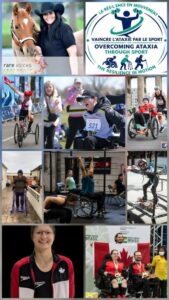
That’s why I created the Facebook page: OVERCOMING ATAXIA THROUGH SPORT

I deeply believe that ataxia, as a symptom, can be partially controlled by sports and exercise.

This page does me a world of good mentally. You can find positive messages, kindness, smiles, and sports performances by people with ataxia.

She reminds me every day that my life doesn’t stop there anymore, but that I have to live it differently.

Written by: France Boily

Edited by: Meg Elmer

We would like to thank France for sharing her inspirational story with us. If you would also like to get involved and share your experience with Ataxia or another rare condition, please get in contact with us through our social media channels or our email.

If you would like to know more about France, you can follow them on Facebook.

Scroll to top